Vernacular media monitoring helps brands track news in the languages their audiences use. However, finding a story is only one part of the job. Understanding its tone matters just as much.
Here’s a simple test you can run yourself.
Take a story that appears in both an English national daily and a Marathi daily on the same day. Both stories may share the same facts about the same company.
However, the English headline may sound neutral, while the Marathi one may have a mocking tone.
A native Marathi speaker may spot the difference at once.
If a tool relies on English translation alone, it may give both stories the same sentiment score.
This gap is why local language monitoring matters so much in India.
Why does regional language coverage matter in India?
India has a wide range of languages. The National Portal of India also provides information on the languages included in the Eighth Schedule of the Constitution.
Newspapers in Hindi, Marathi, Tamil, Telugu, Bengali, Gujarati, Kannada, and Malayalam reach millions of readers.
In fact, local papers can reach more readers than English papers in the same state.
Regional TV channels also play a key role in how people get their news.
For example, a product complaint may first appear in a local paper. The story may then spread to regional TV and national news.
For banks, consumer brands, and listed companies with plants across India, these stories can shape public views.
Therefore, vernacular media monitoring helps PR teams spot issues closer to where they begin.
Our guide to the Bharat gap in regional media monitoring explains why local news coverage matters for Indian brands.
What goes wrong when a tool handles regional languages poorly?
Three common gaps can affect how well your team tracks local news.
1. Important stories go unnoticed
Some tools may cover large regional papers but miss their district editions.
However, local issues often start in these smaller editions.
As a result, your team may miss a story until it reaches a larger news outlet.
2. Sentiment scores may be wrong
Translation can change the tone of a story.
For example, a headline may use sarcasm to criticise a brand. Once translated into English, it may sound neutral.
If a tool misses this tone, your PR team may fail to spot a story that needs a response.
Therefore, it is worth testing sentiment in the original language.
3. Brand names may not match across scripts
Brand and executive names can appear in many forms across Indian languages.
For instance, the same brand name may appear in English, Devanagari, Tamil, or Bengali script.
A search that only uses English keywords may miss some of these mentions.
So, teams should check how well a tool finds names across scripts and different spellings.
How do you test a tool’s vernacular media monitoring coverage?
A high language count does not always mean good news coverage.
Instead, run a simple test with real stories about your brand.
First, collect ten recent news stories. Choose stories about your brand or a rival across at least three Indian languages.
Next, test news coverage. Request each vendor to find the same stories and show when its tool captured them.
Then, check keyword matching. Find out if you need to set up your brand name in Hindi and Tamil separately or if the tool handles this for you.
Review sentiment scores. Pick two of the stories and have a native speaker on your team check whether the scores reflect their tone.
Finally, test broadcast coverage. Check if regional TV news appears in the same feed as print and online news.
This test gives you a clear view of how well a tool meets your needs.
You can also use our step-by-step media monitoring evaluation guide for a wider test of coverage, alerts, pricing, and reporting.
What does good vernacular media monitoring look like?
The right tool should do more than track news in many languages.
Here are five things to look for.
Local print coverage: Look for district and city editions alongside national English newspapers.
Keyword matching: Check whether the tool can find brand, product, and executive names across Indian scripts.
Accurate sentiment: Make sure the tool reflects the tone of the original story.
Broadcast news: Find out if regional TV and radio appear alongside print and online news.
Fast alerts: Test how quickly local news reaches your team, so you have time to act before it spreads.
Together, these features help PR teams get a clearer view of their media coverage.
How does Wizikey handle regional languages?
Wizikey brings Indian and global news into one place.
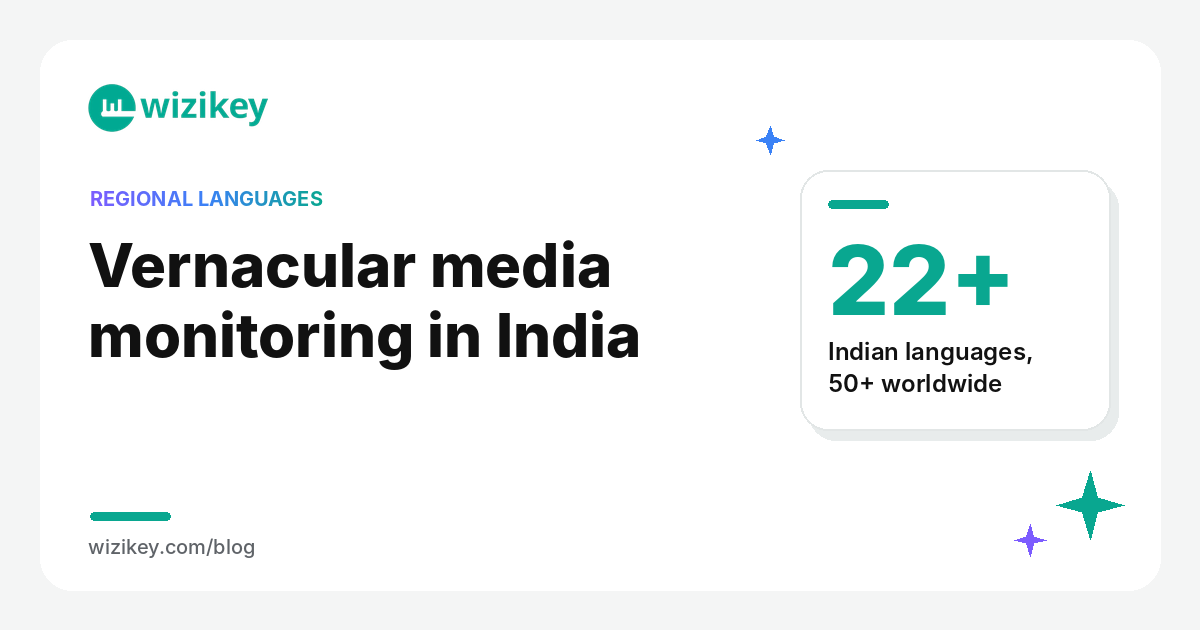
Its stated media coverage includes more than 100,000 sources and over 20,000 Indian publications. The platform covers 50+ languages worldwide, including 22+ Indian languages.
One feed for local and global news
Wizikey brings regional print, TV, radio, online news, podcasts, and social media into one feed.
For example, a Telugu TV mention can appear alongside a story from an English business paper.
Teams can also review sentiment and reach data where available.
As a result, they do not need to check several tools to follow news about their brand.
Fast alerts on the channels your team uses
Local news can spread quickly. Therefore, your team needs to know when a key story breaks.
Wizikey offers alerts through WhatsApp, Slack, Microsoft Teams, email, and the app.
The platform aims to send supported real-time alerts in under two minutes.
This helps teams spot important news and act on time.
AI summaries for regional news
A PR team may not have someone who speaks every language it needs to track.
For example, a team in Mumbai may need to review a story from a Kannada newspaper.
With AI summaries, team members can get the main points of supported regional news stories in English.
However, a native speaker can still help when the exact tone or meaning of a story matters.
This makes vernacular media monitoring more useful for teams that work across many states.
In practice: How Bandhan AMC tracks English and Hindi news
Bandhan AMC uses Wizikey to track news about its brand, funds, and leaders.
The team runs searches in both English and Hindi.
As a result, Hindi news appears in the same dashboard as English business news.
The team can also filter out mentions that have nothing to do with the brand.
Over the year covered by the case study, Bandhan AMC tracked 8,000 online and print news items.
During the reported period, its News Score rose from 44 to 56 out of 100.
This example shows how teams can track news across languages and measure changes in their media presence over time.
FAQs about vernacular media monitoring in India
1. Which media monitoring tools support Indian regional languages?
India-built platforms such as Wizikey, Nemi Insights, and VeeTrack focus on regional news coverage.
Wizikey covers 50+ languages worldwide, including 22+ Indian languages.
Meanwhile, global tools also track some regional news. However, the depth of coverage may vary by source and market.
2. Can media monitoring tools analyse sentiment in Hindi or Tamil?
Yes, some tools offer sentiment analysis for Indian languages.
However, the quality may vary between platforms.
For example, ask each vendor to show sentiment scores on real Hindi or Tamil stories. Then have a native speaker check whether the scores reflect the tone.
3. How do I track my brand name in different Indian scripts?
Choose a tool that can find brand and executive names across different scripts and spellings.
In addition, check whether you need to set up separate keywords for each language.
This helps reduce the risk of missing local news about your brand.
4. Does Wizikey monitor regional TV in India?
Yes. Wizikey tracks regional TV and radio alongside print, online news, podcasts, and social media.
Teams can view supported coverage from these sources in one feed.
As a result, they can get a wider view of news about their brand.
The takeaway: Language coverage decides accuracy
Good media monitoring is not just about the number of sources a tool tracks.
It is also about finding the right stories and understanding what they mean.
In India, a story may start in a local paper, a regional TV channel, or a news site in an Indian language.
Therefore, vernacular media monitoring should be a key part of how PR teams track their brands.
Before you choose a tool, test it with real stories in the languages that matter to your team.
For a wider look at your options, read our guide to the best media monitoring software in India.
Want to see how Wizikey helps teams track news across languages?
Explore Wizikey’s media monitoring platform.
===== 07-Vernacular-media-monitoring =====
<script type="application/ld+json">
{
  "@context": "https://schema.org",
  "@type": "FAQPage",
  "mainEntity": [
    {
      "@type": "Question",
      "name": "Which media monitoring tools support Indian regional languages?",
      "acceptedAnswer": {
        "@type": "Answer",
        "text": "India-built platforms such as Wizikey (22+ Indian languages, 50+ worldwide), Nemi Insights and VeeTrack focus on regional coverage. Global suites cover some regional media with varying depth."
      }
    },
    {
      "@type": "Question",
      "name": "Can media monitoring tools analyse sentiment in Hindi or Tamil?",
      "acceptedAnswer": {
        "@type": "Answer",
        "text": "Some can. Ask vendors to show sentiment on real stories in your languages and have a native speaker check it."
      }
    },
    {
      "@type": "Question",
      "name": "How do I track my brand name in different Indian scripts?",
      "acceptedAnswer": {
        "@type": "Answer",
        "text": "Use a tool that matches brand and executive names across scripts and transliterations, not just in English."
      }
    },
    {
      "@type": "Question",
      "name": "Does Wizikey monitor regional TV in India?",
      "acceptedAnswer": {
        "@type": "Answer",
        "text": "Yes. Wizikey tracks TV and radio alongside print, digital, podcasts and social in one feed."
      }
    }
  ]
}
</script>