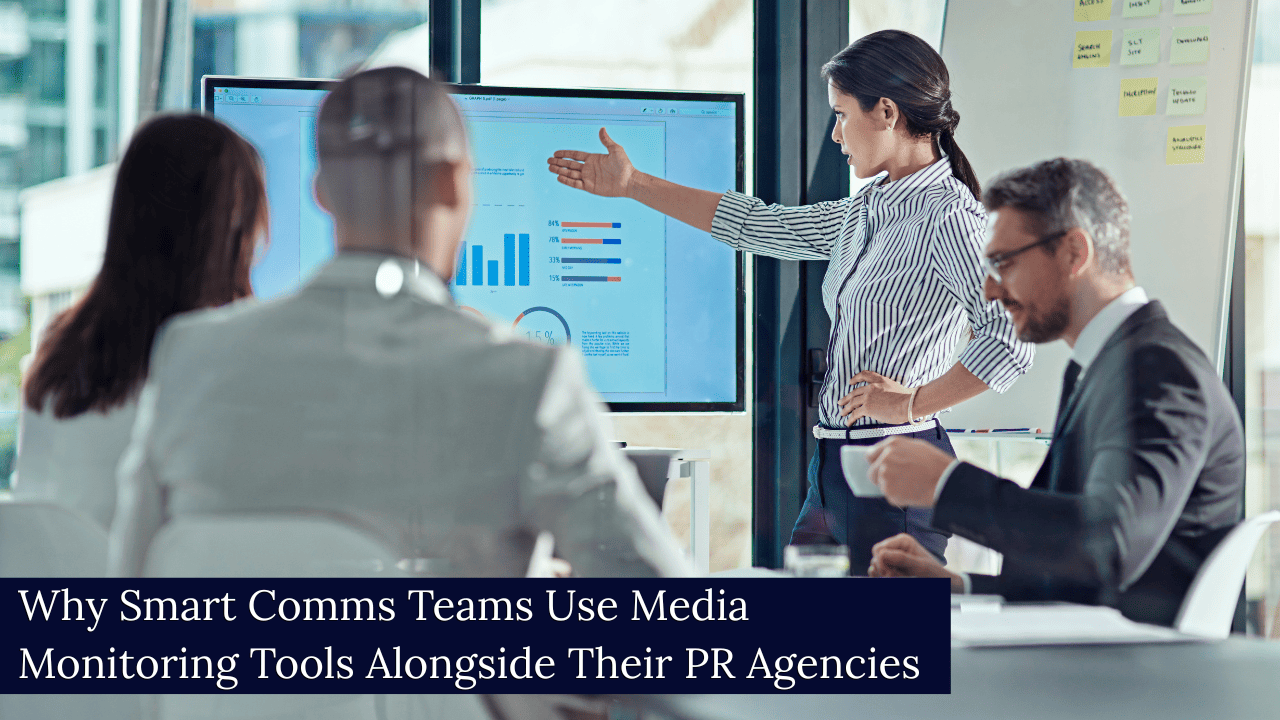
Using media monitoring tools alongside PR agencies is how mature communications teams retain control over media intelligence, improve reporting quality, and stay aligned with leadership expectations.
PR agencies play a critical role in execution — pitching stories, managing journalist relationships, and securing coverage. But as communications becomes more closely tied to business outcomes, comms teams are increasingly expected to provide continuous visibility, competitive context, and leadership-ready insights, not just campaign summaries.
This is why high-performing comms teams don’t choose between agencies and tools.
They use both.
Why isn’t a PR agency alone enough for modern comms teams?
PR agencies are designed for execution.
Communications teams are accountable for outcomes.
According to the PRWeek Global Communications Report (2024), leadership expectations from communications functions have evolved significantly. CXOs increasingly expect more frequent, granular, and on-demand reporting, rather than post-campaign updates.
The same report highlights that:
- Over 60% of CEOs prioritise long-term brand value and sustainable growth
- Revenue impact and business contribution from communications are rising expectations year-on-year
This naturally changes what comms teams are responsible for.
Agencies deliver activity and campaign results.
Internal teams must:
- Answer leadership questions at any time
- Track progress consistently across quarters
- Compare performance against competitors
- Maintain historical context beyond individual campaigns
This gap is structural — not a reflection of agency capability.
What do PR agencies do exceptionally well?
PR agencies bring deep strengths in:
- Media outreach and pitching
- Storytelling and message development
- Journalist relationships
- Campaign execution across publications
- Securing earned media visibility
Earned media remains central to communications strategies. Industry reports consistently show that earned media continues to be one of the most relied-upon channels for brand visibility and credibility.
Agency expertise here is indispensable.
But execution alone does not solve internal intelligence and measurement needs.
What comms teams still need internally
Communications leaders are expected to provide:
- Continuous visibility into coverage performance
- Clear Share of Voice (SOV) and sentiment trends
- Competitive benchmarking
- Narrative and spokesperson performance tracking
- Leadership-ready dashboards that work month after month
However, measurement remains a known challenge.
Industry-wide surveys cited in the ICCO World PR Report (2024–2025) show that a significant portion of comms teams still struggle to connect PR outcomes to broader business and leadership KPIs.
This is one of the main reasons leadership often finds traditional PR reporting incomplete.
Why smart comms teams keep media intelligence in-house
Because accountability sits in-house.
When media data lives only with agencies:
- Insights arrive late
- Comparisons across time become difficult
- Leadership questions require repeated follow-ups
- Reporting formats vary by agency and campaign
By contrast, teams that use a media monitoring tool internally benefit from:
- A single source of truth
- Continuous tracking, not campaign-bound reporting
- Standardised metrics across agencies and regions
- Faster, more confident leadership conversations
This separation — agency execution, in-house intelligence — is increasingly viewed as a marker of communications maturity.
How is agency reporting different from media intelligence?
Agency reports typically summarise outputs.
Media intelligence focuses on outcomes and meaning.
| Area | Agency-led PR reporting | Media monitoring & intelligence (in-house) |
|---|---|---|
| Reporting cadence | Campaign-based | Continuous |
| Primary focus | Coverage and activity | Trends, impact, and context |
| Metrics | Clip counts, reach | SOV, sentiment, narratives, competitors |
| Consistency | Varies by agency | Standardised over time |
| Leadership readiness | Often needs rework | Dashboard-ready |
| Accountability | Hard to benchmark | Easier to compare objectively |
This difference explains why leadership teams often ask follow-up questions even after reports are shared.
Why Share of Voice and competitive context matter
Frameworks such as the AMEC Global Measurement Framework emphasise the importance of comparative and outcome-oriented metrics in communications evaluation.
Share of Voice helps comms teams answer questions like:
- Are we gaining or losing visibility vs competitors?
- Which themes are driving that movement?
- Where are competitors outperforming us?
Industry polling consistently shows that SOV is tracked frequently by communications teams, underlining how central competitive context has become to decision-making.
These insights require continuous tracking — something static reports struggle to provide.
How media monitoring tools improve agency collaboration
Media monitoring tools don’t replace agencies.
They improve collaboration.
With shared visibility:
- Definitions and metrics are aligned
- Coverage gaps are identified earlier
- Performance discussions become objective
- Monthly reviews shift from justification to optimisation
This reduces friction and improves outcomes for both sides.
How Wizikey fits into the “agency + in-house intelligence” model
Wizikey is used by communications teams as an internal intelligence layer that complements agency execution.
Teams typically rely on Wizikey for:
- Ongoing media intelligence (SOV, sentiment, competitors, narratives)
- Leadership-ready reporting and dashboards
- Reviewing and aligning agency performance
- Reducing manual reporting effort
This model works especially well for organisations with:
- Multiple agencies
- Distributed teams or geographies
- Lean comms functions with high leadership visibility
How to set up an effective agency + media monitoring workflow
Step 1: Define leadership-level questions
Examples:
- How is our SOV trending quarter-on-quarter?
- Which themes are seeing sustained media pickup?
- How do we compare against competitors right now?
Step 2: Align on tracking rules
Agree on:
- Keywords and competitors
- Sentiment definitions
- Coverage tiers and categories
- Reporting cadence
Step 3: Use a single source of truth
Let the agency execute, while the internal team tracks performance continuously.
Step 4: Run smarter reviews
Focus on:
- What improved
- What didn’t
- What to change next
Step 5: Track outcomes over time
Consistency across months and quarters is where intelligence compounds.
Why comms teams are moving away from spreadsheets
The Global CommTech Report (2024) highlights a clear operational shift:
- 80% of communications teams cite time savings as the biggest benefit of modern comms technology
- 59% cite improved productivity
- The report cautions against continued reliance on spreadsheets and fragmented tools for reporting
Centralised platforms are becoming the norm as comms teams scale.
Key takeaways
- PR agencies are execution experts — and remain essential
- Communications teams are accountable for outcomes and leadership reporting
- Media monitoring tools keep intelligence in-house
- The strongest setup is agency + intelligence, not agency alone
- Wizikey helps teams improve reporting, alignment, and confidence
References
- PRWeek (2024) – Global Communications Report
– Leadership expectations, earned media reliance, reporting maturity
https://www.prweek.com - AMEC – Global Measurement Framework
– Outcome-focused PR measurement and evaluation standards
https://amecorg.com - ICCO (2024–2025) – World PR Report
– Measurement challenges and evolving expectations in global PR
https://iccopr.com - PRovoke Media x Purposeful Relations (2024) – Global CommTech Report
– Productivity, automation, and the move away from spreadsheets
https://purposefulrelations.com