By Anshul Sushil
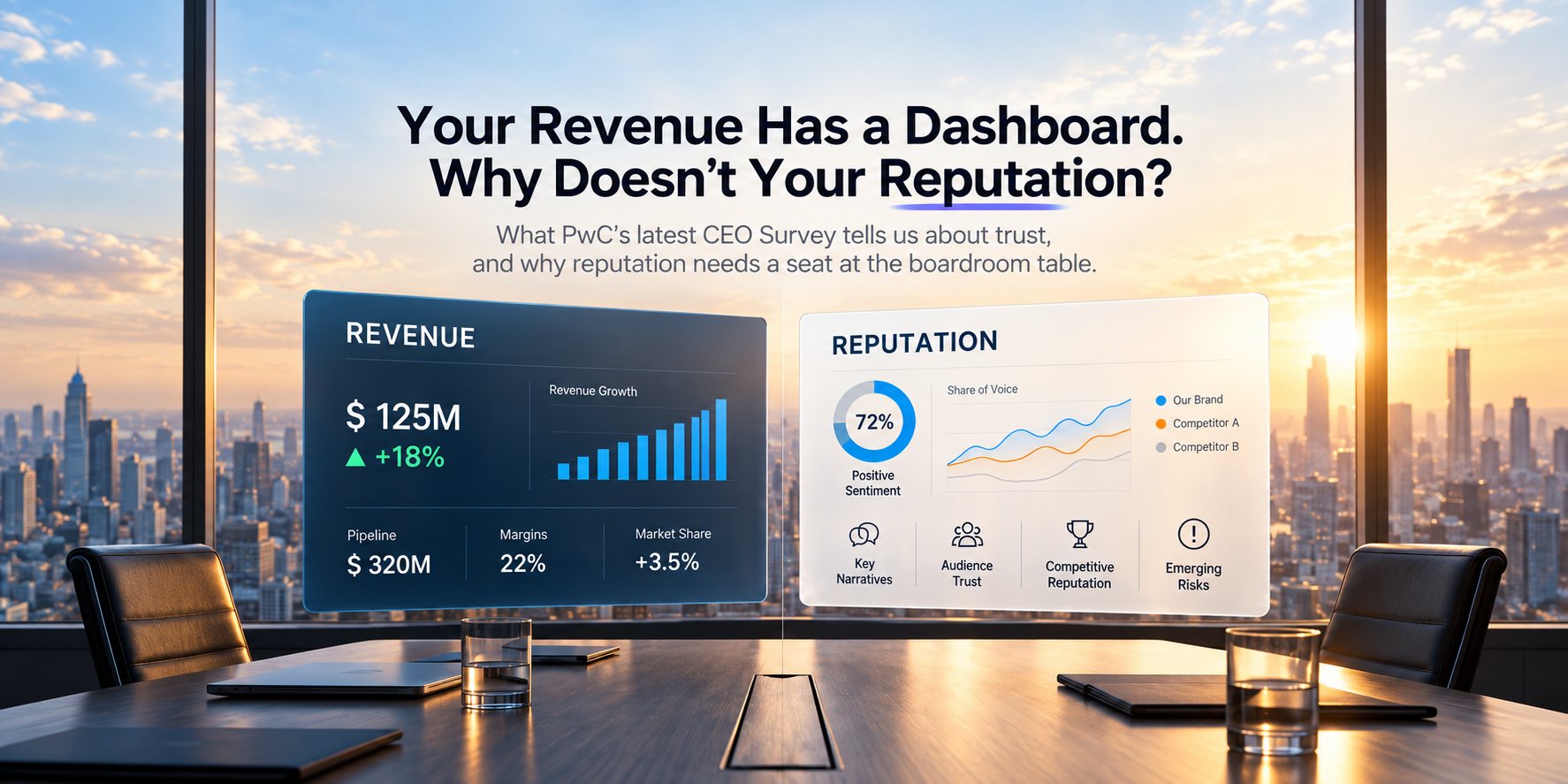
Every CEO knows the numbers. Revenue has a dashboard. Pipeline has a dashboard. Growth has a dashboard. Yet few leaders have a reputation dashboard. That means they often lack a clear view of what the market believes about their company.
For this reason, that gap matters.
PwC’s 29th Global CEO Survey makes a useful link between trust and business results. The survey found that 66% of CEOs had faced stakeholder trust concerns. These concerns were moderate or greater during the previous year.
In addition, PwC looked at listed companies in its sample. It compared those answers with shareholder returns.
The companies with the fewest trust concerns did better. On average, their total shareholder returns were nine percentage points higher over 12 months. The comparison was with companies reporting the most trust concerns.
That does not prove that trust caused the difference. However, the result was strong enough for PwC to make a direct recommendation:
“Make trust a boardroom topic.”
I agree. And I would take that idea one step further.
Why a reputation dashboard belongs in the boardroom
Companies have spent decades building systems for key business assets.
Sales has Salesforce. Marketing has funnel analytics. Finance has dashboards. Customer teams track NPS, retention and churn. HR tracks engagement and attrition.
Reputation matters just as much. It can shape how customers, employees, investors, regulators and partners see a company.
However, leaders often see reputation through a narrow set of PR metrics:
- How many articles did we get?
- What was our share of voice?
- Was the coverage positive or negative?
- How many people did we reach?
Of course, these numbers are useful. I have spent a large part of my career working with them.
However, they mainly measure communications output. They do not always answer the questions a CEO needs to ask.
For example:
- What are we becoming known for?
- Is that what we want to be known for?
- Which narratives are gaining momentum?
- How does the market see us versus our competitors?
- Where is trust getting stronger?
- Where may it be getting weaker?
Most of all, leaders need to know one thing:
Is something changing outside the company that needs action?
That is a very different conversation.
From media monitoring to reputation intelligence
For a long time, communications had an information problem.
Understanding reputation at scale was hard. Companies could track newspapers and television. They could run perception studies. Teams could also speak with journalists, customers and analysts.
Even so, much of reputation was hard to see in real time.
However, that is changing.
Today, reputation takes shape across media monitoring, social media, search, online communities, customer conversations and AI systems.
At the same time, AI can study large amounts of unstructured data. It can also spot patterns much faster than before.
As a result, communications teams can see shifts earlier. They can understand what is changing. They can also ask why it is changing.
Therefore, this creates a real opportunity.
The next generation of communications leaders can move beyond asking:
“What coverage did we receive?”
Instead, they can help the business ask:
“What is happening to our reputation, why is it happening, and what should we do about it?”
That is not just better PR measurement.
That is reputation intelligence.
What should a CEO reputation dashboard show?
If I were designing a reputation dashboard for a CEO, I would want it to answer five questions.
1. What are we known for?
First, start with the outside view.
What does the market actually link with us?
For example, a company may want to own a certain idea. It may also want to lead a category. However, customers or journalists may see it differently. Investors may have another view. AI systems may show another pattern.
For this reason, that gap matters.
2. What is changing in our reputation?
Reputation is not static.
Narratives emerge. Issues grow. Conversations fade. Competitors shift their position.
Therefore, leaders need to see change, not just volume.
Which narratives are gaining pace? Which issues are fading? What has suddenly started to draw attention?
Therefore, those shifts can matter more than the total volume of mentions.
3. Who trusts us, and why?
There is no single audience called “the market.”
For example, customers may see a company one way. Employees may see it another way. Investors, partners, journalists and regulators may also have different views.
A useful measurement tool, such as Wizikey News Score, can help teams make sense of some of these signals.
In addition, it can show where the picture is changing.
4. How do we compare with competitors?
Reputation is relative.
However, your company does not operate alone. Competitors are also shaping narratives. They are building authority. They are earning trust.
So leaders should ask:
What does a competitor own in the market’s mind that we do not?
For example, the answer may point to an opportunity. It may show a weakness. Or it may reveal a wider shift in the category.
5. What requires action?
Above all, this may be the most important question.
The best reputation intelligence should not only describe yesterday. It should help leaders decide what to do next.
For example, an emerging narrative may need a response. A competitor may gain authority around an important topic. That may call for stronger communication.
A sudden change in sentiment may also need attention. If caught early, the team has more time to respond.
In other words, the goal is not another dashboard for the sake of it.
Instead, the goal is better decisions.
Therefore, that is where I believe communications has its biggest opportunity.
How reputation intelligence changes communications
For years, communications professionals have argued for a seat at the leadership table.
Perhaps the way to earn that seat is not to show more coverage. Instead, it is to bring the business insight that nobody else can.
In fact, communications leaders sit between the company and the outside world.
For example, journalists begin asking new questions. New narratives start to form. Employees raise concerns. Competitors change their position. A CEO’s words travel far beyond the room.
At the same time, data can bring these signals together.
As a result, the future communications leader can become more than the person who tracks press coverage.
They can become the custodian of reputation intelligence.
Why a reputation dashboard belongs beside revenue
If PwC is right, trust deserves to become a boardroom topic.
So there is a simple place to start.
At the next leadership meeting, put the revenue dashboard on the screen.
Then show the pipeline dashboard.
Next, show the customer dashboard.
Finally, put up one more:
The reputation dashboard.
Then ask the question that matters:
What is the world beginning to believe about us — and what are we going to do about it?
About the author
Anshul Sushil is an engineer who chose communications. He is also a communications professional who ended up building technology.
An IIT–MICA alumnus, he has led global marketing at HCL. He has worked with high-growth technology companies. He has also advised more than 20 growth-stage startups.
Today, as Co-founder of Wizikey, he works at the intersection of AI, data and communications. His ambition is to make reputation intelligence a business function. He also wants communications to have a bigger seat at the CEO’s table.