Why sentiment matters
Volume tells you that people are talking about your brand. It does not tell you whether that conversation is working for you or against you. For example, a month with 300 mentions could represent an excellent campaign or a serious reputational issue. However, the number alone cannot explain the difference.
That gap shows up the moment coverage data reaches anyone outside the comms team. A campaign launch and a product recall may create similar spikes on a media monitoring chart. Yet leadership cannot understand what those spikes mean by looking at volume alone. Sentiment is what turns a number into something a business can act on.
For a comms team, it changes three things:
- You catch problems while they are still small. A rising share of negative coverage is an early signal, often visible before overall volume moves at all.
- You can benchmark honestly. Knowing a competitor out-published you is one thing. Knowing they out-published you while carrying twice your negative share is a different conversation.
- You can show the value of the work. Coverage counts prove activity. A shift in sentiment over time proves impact.
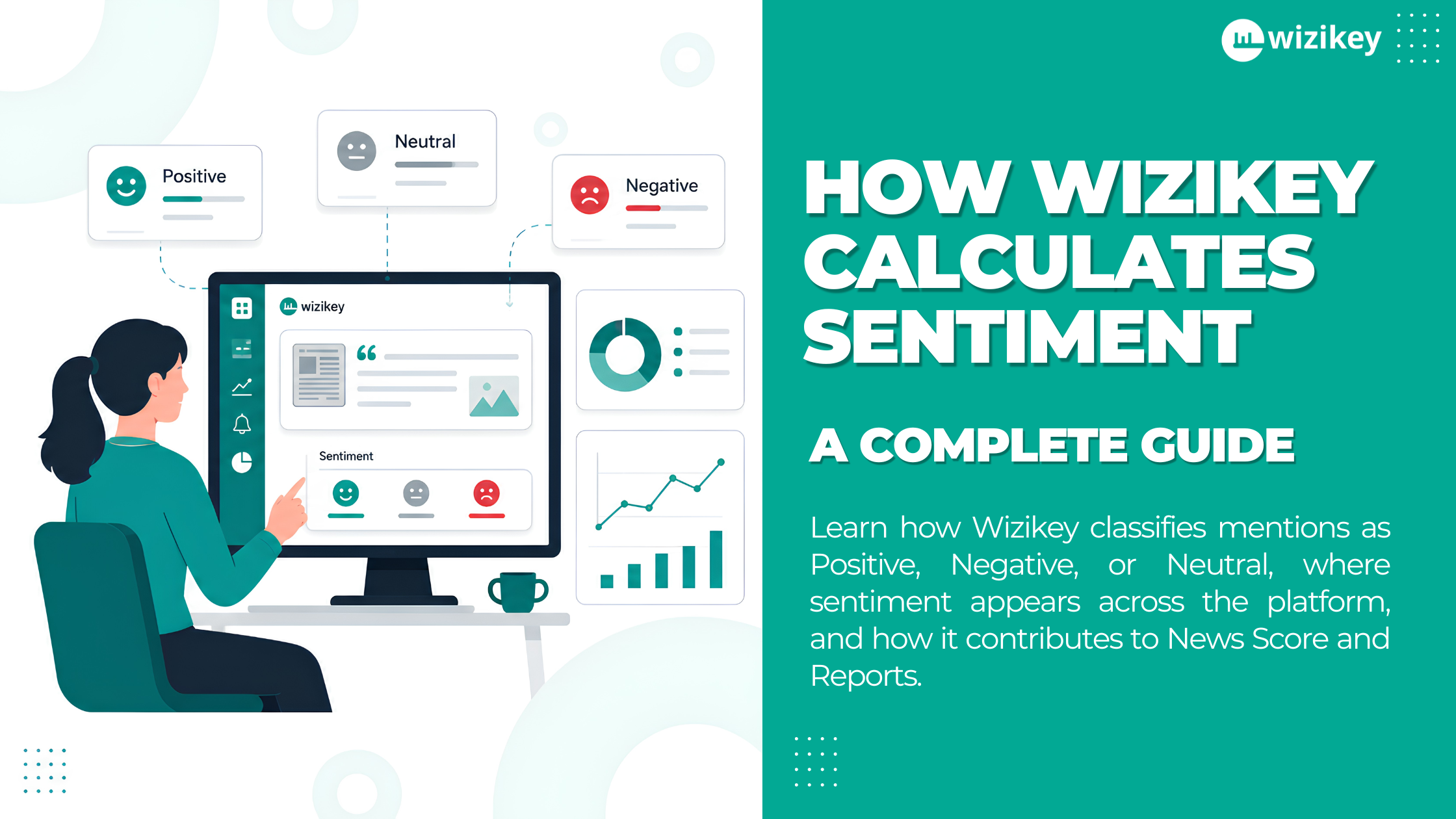
This guide explains how Wizikey calculates sentiment, where you can find it across the platform, how you can change a classification, and how sentiment contributes to your News Score and Reports.
The three classifications
Every mention Wizikey picks up for your brand is classified as one of three values:
- Positive: the coverage works in your brand’s favour
- Negative: the coverage reflects poorly on your brand
- Neutral: your brand is mentioned without a clear positive or negative slant, which is common in listings, market roundups and passing references
Neutral is not a fallback for coverage the system could not read. It is a meaningful outcome in its own right, and for most brands it accounts for a large share of total coverage.
How Wizikey Calculates Sentiment
To understand how Wizikey calculates sentiment, it is important to know that Wizikey evaluates the coverage from your brand’s perspective rather than assigning one sentiment to the entire article.
Two things are taken into account. The first is the headline. The second is the context in which your brand actually appears in the body of the article, meaning the text immediately surrounding each point where your brand is mentioned, rather than the article read end to end.
That distinction matters more than it might sound. A long market report might carry a gloomy overall tone while the two lines that mention your brand are complimentary. Reading the article as a single block would classify that mention as negative. Reading the context around your brand gives you the answer you actually need.
Both signals, the headline and the body context, are considered together before a single classification is assigned to that mention.
Where sentiment analysis is available
Sentiment analysis runs across every media type Wizikey tracks:
- Online News
- Print News
- YouTube
- X (Twitter)
- Broadcast
This consistent approach means Wizikey calculates sentiment in the same way across news, social media, and broadcast. So you are not reading the tone of your news coverage in one place and guessing at the tone of your social coverage somewhere else. It is the same three classifications applied consistently across every channel: all your data, in one single view.
How Wizikey Calculates Brand-Specific Sentiment
One article can carry different sentiment for different brands, and that is by design.
Take a story comparing five companies in the same sector, where one is praised and another is criticised. Because Wizikey reads the context around each brand’s own mention, that single article can be Positive for one brand and Negative for another. Both are correct. They are answering different questions.
This is worth keeping in mind when you compare your sentiment split against a competitor’s. You are not looking at two readings of the same set of articles. You are looking at how each brand was treated within them.
Sentiment is subjective, and the final call is yours
Two people can read the same article and land on different conclusions about it. That is the nature of sentiment. A mention that reads as ordinary to one team may carry weight for another, depending on what is happening around the brand at that moment, who the publication is, and what the coverage is being compared against.
Wizikey gives you a starting classification for every mention, and you keep the ability to set it the way your brand sees it. On any mention card, sentiment appears as a dropdown alongside the other tags for that story. Open it and select the value that fits.
Two things to know about how a change behaves:
It applies everywhere, not just on that card. Once you change a classification, the mention counts under its new sentiment across your dashboard, your News Score and your reports. It is a correction to the data, not a cosmetic relabelling.
It is scoped to your brand and your workspace. If the same article appears in two workspaces, changing the sentiment for a brand in one workspace does not change it in the other. And within the article, the change applies only to the brand you changed it for. Another brand mentioned in the same story keeps its own classification.
Sentiment defined the way your industry reads it
Positive, Negative and Neutral are the same three labels for everyone. What counts as each of them is not.
Ask ten people to rate the same dish and you will get ten different answers. What one person calls fiery, another calls barely seasoned. Nobody is wrong. They are working from different reference points. Media coverage behaves the same way. A regulatory mention is routine in BFSI. A lawsuit is part of the landscape in legal coverage. A side-effect reference is standard in healthcare reporting. Judged by a generic rulebook, all three look negative. Judged in context, none of them are.
A generic sentiment model treats a regulatory mention the same way whether it lands on a bank or on a consumer brand. For the bank, that mention may be entirely routine, the sort of thing that appears every quarter and tells the comms team nothing new. Counted as negative coverage, it distorts the picture and buries the mentions that actually deserve attention.
You can ask the Wizikey team to define sentiment the way your industry reads it. Working with you, we build a custom sentiment prompt tuned to your brand, your sector and the context that matters to your business, so that routine coverage is read as routine and genuine risk stands out.
It is not a setting you configure on your own. It is something you ask for, and we build it around how your industry actually talks.
Sentiment inside your News Score
News Score measures how visible your brand is. Sentiment tells you what that visibility is worth.
A brand can post a strong News Score on volume alone while a significant share of that coverage works against it. To close that gap, Wizikey offers a sentiment-enabled News Score, which factors coverage quality into the visibility metric.
It works in two steps:
Sentiment Score = (Positive mentions + Neutral mentions) ÷ Total mentions
Sentiment-enabled News Score = News Score × Sentiment Score
So a brand with a News Score of 50 and a sentiment split where 80 percent of coverage is Positive or Neutral arrives at 50 × 0.80, or 40.
Notice that Positive and Neutral are counted together. This is deliberate. The question the score is answering is not how much of your coverage was flattering, but how much of it was free of reputational damage. A neutral listing does not help your reputation, but it does not hurt it either, and grouping it with negative coverage would penalise brands for perfectly ordinary mentions.
For a fuller explanation of the methodology and what it changes about PR measurement, read Wizikey’s Sentiment-Enabled News Score.
Sentiment in your reports
Sentiment carries through into your reports, and you choose which views to include from the Select Slides window when you generate one.
Brand Coverage Report. A Sentiment Analysis slide for each media type, showing the share of Positive and Neutral mentions against Negative mentions for the reporting period.
Competition Comparison Report. Brand Share of Sentiment, broken into Positive, Neutral and Negative. Each view shows how your share of that sentiment compares against your competitors, with a brand-wise breakdown of counts.
Self Comparison Report. The same sentiment views placed across two date ranges side by side, with a callout showing how your position has moved from the previous period.
Faceoff Analysis. A Sentiment Analysis view for each media type, so a head-to-head comparison covers tone as well as volume.
Some views group Positive and Neutral together while others separate all three. The grouped view answers a summary question, which is how much of your coverage carried no reputational risk. The three-way split is for when you need to see where the movement is coming from.
Frequently asked questions
Can the same article be Positive for one brand and Negative for another? Yes, and it often is. Sentiment is calculated per brand.
What happens if I change a sentiment? The mention counts under its new value across your dashboard, News Score and reports. The change applies to that brand within that workspace.
Why do Positive and Neutral get counted together in the News Score? Because the score is measuring how much of your coverage was free of reputational damage. Neutral coverage is not favourable, but it is not harmful either.
Is sentiment available on social media as well as news? Yes. It runs across online news, print, YouTube, X (Twitter), Instagram, LinkedIn, Reddit, Facebook and Broadcast.
Can sentiment be tailored to my industry?
Yes. Ask the Wizikey team and we will build a custom sentiment prompt for your sector.